
Due to increasing temperatures in the summer months, the need for air conditioning is becoming an absolute necessity. In the given situation your first concern may be whether you need planning permission for air conditioning in London or not.
This guide for 2026 details everything you need to know: how the planning system works in the UK, what types of developments are considered permitted, and how you can determine if you need to contact your local council.
Even if you are not a homeowner, a landlord, a tenant, or a business owner in London, you will need to familiarise yourself with the legal air conditioning system regulations to avoid the possibility of a relatively easily avoidable fine or enforcement notice. Let’s dive in.
What is Planning Permission, and Why is it Important?
Planning permission is the approval from your local council (in London, it’s one of the 32 London boroughs or the City of London) that your construction project complies with local and national planning regulations.
Usually, alterations that have a considerable impact on the exterior of a building or the way it looks from the street may require planning permission.
It is necessary to know whether you need permission before you install to avoid fines and enforcement actions.
Planning Permission for Air Conditioning: General Rule in the UK (and London)
In the UK, most small home air conditioning installations do not need planning permission. They actually come under something called permitted development rights. If your planned installation meets certain criteria, you can install an air conditioning system with no planning permission needed.
Here’s what that means:
- Permitted development rights mean you can do certain types of work without planning permission.
- These rights are mostly for small domestic properties and small external units.
If you are planning a bigger system or commercial unit or want an odd spot for your unit, you may need planning permission.
When You Might Not Need Planning Permission
For a lot of homeowners in London, planning permission for air conditioning is not needed if:
External unit size is small
Your condenser (aka, outdoor unit) should be smaller than 0.6 cubic metres. This size restriction is crucial. An outdoor unit bigger than this could mean your installation is considered a structural change and may require planning permission.
The installation location is suitable
Under ‘permitted development rights’, this means:
- The unit should be wall-mounted at ground level (or a little above), not on a pitched roof.
- It should not be too close to a flat roof edge (usually at least 1 metre).
- It must not change how your house looks from the street.
It’s not a listed building or conservation area
People who live in listed buildings and conservation areas like Westminster, Kensington and Chelsea, or portions of Tower Hamlets may require planning permission even for small units.
It’s for domestic use only
In fact, planning permission is usually needed for commercial air conditioning systems because they are usually larger and can affect the building.
When Do You Need Planning Permission?
Most air conditioning installations are covered under permitted development, but planning permission for air conditioning might be required in these circumstances:
-
Listed buildings
In case your home in London is a listed building. You generally need listed building consent in addition to planning permission, as these buildings are preserved due to historical or architectural significance.
-
Conservation areas
Houses in conservation areas may require listed building consent. Conservation areas frequently impose tighter controls on the appearance, even for small installations.
-
Commercial properties
Planning permission is typically required for the installation or modification of air conditioning systems in retail shops, offices, warehouses, and other commercial buildings. These buildings are bigger and may impact neighbours, the streets, and noise levels.
-
Large or multiple units
Planning permission is typically required for multiple external units, rooftop units, or for any unit that exceeds 0.6 cubic metres.
-
Sensitive areas
Local councils may still take action in cases where locations are sensitive and may be covered by permitted development rights. For example, if there is an AC unit that is excessively loud, permission and a noise assessment are needed.
How Long will it Take to Get Planning Permission
Most planning applications take 8-13 weeks to get a decision, but it really depends on your specific case. Drawings, location plans, and a justification for the installation may be required.
Step-By-Step: Assessing Your Position to Obtain Planning Permission
Step 1: Understand Property Type
Is it a house, flat, listed building, or leasehold?
Step 2: Understand Conservation Status
Check your borough website. For instance, the London Borough of Camden has detailed planning guidance on their website.
Step 3: Understand Lease Terms (if applicable)
Check your lease before doing anything!
Step 4: Contact a Professional Installer
They can help with on-site noise mitigation.
Step 5: Think About Pre-Application Advice
If in a sensitive area, it would be wise.
What happens If You Install without obtaining Planning Permission
If you don’t get planning permission, you could get fines, enforcement notices, or a lawsuit. When selling properties, buyers can delay the transaction or renegotiate if missing approvals affect the mortgage.
Planning Permission Cost and Timeline
Every borough has their own set of costs, but most residential fees are:
- £200–£300 for householder planning applications
- listed building consent may carry different fee structures
Timeframes usually range from:
- 6–8 weeks for standard decisions
- Longer, if objections are raised
- Extended timelines in conservation or heritage cases
In many boroughs, pre-application advice services are available for an additional fee and can reduce refusal risk.
Air Hive Uk Offers Expert Air Conditioning Installation and Planning Advice
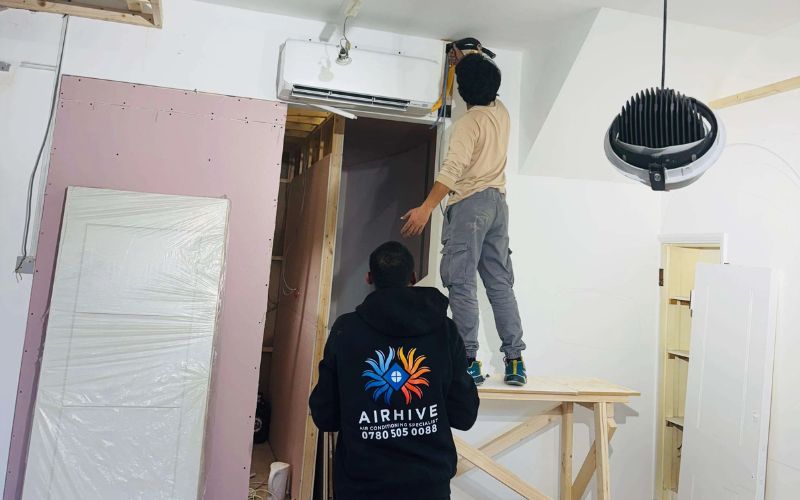
Air Hive UK provides professional services for air conditioning installation in London. Being specialists in installation, maintenance, and consultation services, Air Hive also assists homeowners and proprietors with planning permission compliance. The professional team at Air Hive UK makes sure that units are legal in terms of size and position and fully operational.
Frequently Asked Questions
Do I always need planning permission for AC?
No, planning permission is not usually required for small domestic units as long as they comply with certain regulations regarding their size and position.
When is planning permission required?
For large units, more than one unit, and units in listed buildings or located within conservation areas.
Can I install AC in a flat or shared property?
Yes, but you must obtain permission from your landlord/builder management to install the unit on shared walls or balconies.
What are the consequences for installing AC without permission?
Potential fines, enforcement notices, forced dis/re-activation, and complications in the event of a sale.
Can professional installers assist with planning permission issues?
Yes, AirHive UK offers advisory services and assists in surveying to ensure installations comply with relevant planning regulations.