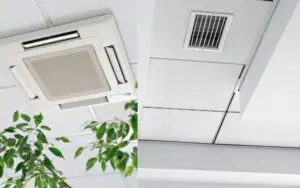
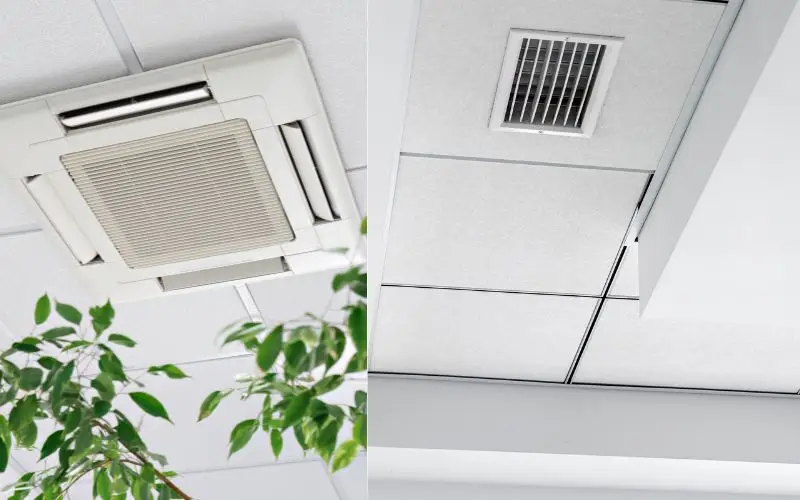
Choosing between a ceiling cassette and a ducted air conditioning system is not about picking the more powerful one. The best choice depends on your building layout, the space above the ceiling, the number of rooms, how the system will look and how easy it will be to maintain.
Both can cool and, with a reversible system, heat a home or business if they are designed and installed well. This guide compares them in plain terms, with London homes, offices and shops in mind.
A ceiling cassette usually suits a single large or open-plan room, such as an office, shop or living room. Ducted AC suits properties where you want the equipment hidden, or one system serving several rooms, as long as there is enough space above the ceiling for the ductwork. A site survey is the only reliable way to know which will work for your building.
Ceiling Cassette vs Ducted AC at a Glance
Ceiling cassette |
Ducted AC |
|
| What you see | A square panel set into the ceiling | Only small grilles or vents |
| How air is delivered | Spread from the ceiling, often in several directions | Through hidden ducts to grilles in each room |
| Best for | Open-plan offices, shops, salons, restaurants, large living rooms | Larger homes, renovations, multi-room or whole-property cooling |
| Space needed above the ceiling | A void deep enough for the cassette body | A void for the indoor unit and ductwork |
| Installation | Often simpler in a suitable open space | Usually needs more planning, duct routes and grille positions |
| Appearance | Visible panel, but compact | Most discreet |
| Maintenance access | Filters and panel are accessible from the room | Needs a good access panel to the indoor unit and filters |
What is a Ceiling Cassette?
A ceiling cassette is an indoor unit set into the ceiling. Most of the unit sits in the void above, and only a flat panel with air outlets shows in the room. It spreads air out around the room, which can give more even cooling or heating in open spaces than a wall unit.
Cassettes are often designed to fit standard ceiling tile grids, so they are popular in offices and shops with suspended ceilings. They are a good fit for:
- open-plan offices
- shops, salons and restaurants
- large living rooms
- rooms where wall space is limited
What is Ducted Air Conditioning?
A ducted system has an indoor unit, usually hidden in a ceiling void or loft, connected to ductwork. Cooled or heated air travels through the ducts and comes out of grilles in the rooms. Because most of the equipment is out of sight, ducted AC is popular where appearance matters.
It can work well for:
- larger homes
- renovations and new builds
- offices and larger commercial buildings
- properties where visible indoor units are not wanted
- projects where several rooms need cooling
The key requirement is space. The ductwork needs somewhere to go, so ceiling voids and lofts must be checked before installation.
Which One is Better for You?
Neither is always better. It depends on the property.
A ceiling cassette may suit you if:
- You have one large or open-plan room.
- The ceiling void is deep enough and accessible.
- You want even air distribution without a duct network.
Ducted AC may suit you if:
- You want the equipment hidden.
- You want to cool several rooms from one system.
- You are renovating and ceilings are being opened or redone anyway.
- You have enough space for the ducts.
For individual rooms, a wall-mounted split or multi-split system may be simpler and more cost effective than either. It is worth considering all the options before you decide.
What About London Homes and Businesses?
London properties bring some extra things to think about.
- Period homes: Victorian and Edwardian houses often have decorative ceilings, cornices and plaster details. Cutting into them for a cassette needs care, and ducted systems may need to be routed through lofts or boxed-in areas.
- Flats: Ceiling voids are often shallow, and there may be limited space for ductwork. If you rent or own a leasehold flat, you will usually need permission from your landlord or freeholder.
- Offices: Many have suspended ceilings and tiled grids, which suit cassettes well. If you are leasing the space, check what your lease allows.
- Shops, salons and restaurants: Cassettes spread air through open sales or dining areas, but the best choice depends on occupancy, layout, kitchen extraction and noise. Air Hive UK offers commercial air conditioning services in London for offices, shops and restaurants.
What Affects the Installation?
The installation matters as much as the equipment. An installer should consider:
- Room size and layout
- Ceiling construction and the depth of the void
- Position of the outdoor unit
- Refrigerant pipe route
- Condensate drainage (cassettes and ducted units often need a pump if gravity drainage is not possible)
- Electrical requirements
- Access for installation and future maintenance
- Airflow needed
- Noise
- Whether you need heating as well as cooling
Correct sizing is essential. An oversized system can switch on and off too often, and an undersized one will struggle to keep the space comfortable. Sizing should be based on a proper heat load assessment of your property, not a rough guess from the floor area.
Is Ducted AC More Expensive Than a Ceiling Cassette?
There is no guaranteed answer. Ducted systems may need extra work, such as duct routing, grille positions and ceiling access. A cassette in a suitable open space may be simpler to fit. But the final cost depends on:
- the size of the property and the number of rooms
- the number of indoor units and the system capacity
- access to the ceiling and the need for ducting
- pipe lengths and electrical work
- condensate drainage and the outdoor unit position
- the complexity of the installation
Be careful with indicative prices for one type of system. A price for a wall-mounted unit does not tell you what a cassette or a ducted installation will cost. Air Hive UK offers free site surveys and fixed quotes, so you can compare real prices for your property.
Which is More Energy Efficient?
Efficiency depends on the equipment, the design, the controls, the building and how you use it. A well-designed system matches the needs of the building rather than being the biggest unit available. Inverter systems can adjust their output to the room temperature instead of running at full power, which can help save energy.
For either type, you can save energy by:
- avoiding extreme temperature settings
- using timers and controls
- keeping filters clean
- keeping airflow clear
- servicing the system regularly
- choosing a correctly sized system
Maintenance and Access
Both systems need regular servicing. Filters, coils, electrical parts and drainage all need checking, and performance should be tested. Ducted systems also need good access to the indoor unit and the filters, so think about this before the system is fitted. Air Hive UK offers air conditioning servicing and maintenance in London, including cleaning, filter checks, electrical safety checks and performance tests.
Planning Permission and Building Regulations
Not every air conditioning installation needs planning permission. It depends on the property and the works. Listed buildings, conservation areas and some other restricted properties may need extra consent, and the outdoor unit position can matter.
Planning permission and Building Regulations are separate things. Some fixed air conditioning work may be covered by Building Regulations, and larger commercial systems can have extra requirements. Anyone who works on refrigerant must be properly qualified under F-Gas rules. Before work starts, ask your installer to confirm what applies to your project, and check with your local council or building control if you are unsure.
Common Mistakes to Avoid
- Choosing on equipment price alone: Installation quality, efficiency and maintenance all affect the long-term cost.
- Ignoring the ceiling void: Both systems need enough space above the ceiling, and ducts need a route.
- Getting the size wrong: Capacity should come from a heat load assessment.
- Forgetting future maintenance: Think about how engineers will reach filters, drains and indoor units.
- Forgetting appearance and noise: Consider where grilles, panels and outdoor units will sit.
- Forgetting heating: Many systems can cool and heat. If you want year-round comfort, discuss it first.
Getting Advice From Air Hive UK
Air Hive UK is based in Hounslow and works across London and the Home Counties. Our air conditioning installation in London service covers split, multi-split and ducted systems for homes and businesses. Our engineers are F-Gas certified, and we offer a free site survey and fixed quote. If you are unsure whether a cassette or ducted system will work in your building, a survey is the best place to start. Contact us for friendly advice.
Frequently Asked Questions
Is a ceiling cassette better than ducted air conditioning?
Not always. Cassettes suit open-plan rooms, while ducted systems suit properties where hidden equipment or multi-room cooling matters most. It depends on your layout.
Is ducted AC suitable for a London home?
It can be, especially in larger homes, renovations and new builds where the ducts can be hidden easily. A site survey will show whether your ceiling or loft has enough space.
Are ceiling cassettes suitable for offices?
Yes. They are a popular choice for open-plan offices, because they spread air from the ceiling and leave the walls free.
Is ducted AC more expensive than a cassette?
It depends on the installation. Duct routing, ceiling access and the number of rooms all affect the price. A survey gives you a real quote.
Which is best for a large open-plan room?
A ceiling cassette often works well, as it spreads air across the room. Ducted AC is an alternative if you want a less visible system.
Do these systems need servicing?
Yes. Filters, coils, drainage and electrical parts need regular checks, and ducted units need good access for maintenance.
Do I need planning permission?
It depends on the property and the installation. Listed buildings, conservation areas and leasehold properties may have extra rules, so check before work starts.
Final Thoughts
When you choose between a ceiling cassette and ducted AC, start with the building, then choose the equipment. Cassettes are a good fit for open-plan rooms and commercial spaces. Ducted AC is better when you want the system hidden or one system for several rooms, provided the ducts have space.
If you are not sure, a professional survey is the best next step. The right choice will balance comfort, appearance, installation, efficiency and your future needs.