Why Do You Need AC Maintenance?
Let’s discuss why it is a good thing to maintain the air conditioner before we discuss how you should do it. Your AC labours all day to cool your home. Dust, dirt, and other impurities will, over time, reduce its efficiency. If at all you maintain it, your AC will consume less power, have a longer lifespan, and perform more efficiently.
1. Replace or Clean the Air Filters
One of the easiest things to do to keep your air conditioner running in good condition is to change or clean the air filters. The air filters catch dust and dirt present in the air. When the filters are extremely dirty, your AC will have to overwork, and that will incur extra dollars.
How to replace or clean the air filters:
Switch off your AC.
Remove the front panel of the AC.
Pull out the filter.
If dirty, wash it with soap and water. Please leave it to dry beforehand before you reinstall it.
If it’s too dirty and you can’t clean, use a new one.
2. Test the Thermostat
The thermostat is the device that regulates temperature in your home. If it does not work properly, your AC won’t cool your home as you would like.
How to test the thermostat:
Ensure that the thermostat is set at the preferred temperature (approximately 18-21°C).
Test the thermostat by turning on the AC and sliding the thermostat to a cooler temperature. The AC will begin to cool.
Replace the thermostat if it is faulty.
3. Clean the Fins and Coils
Coils and fins in your AC cool your home. The evaporator coils remove heat from the air, and the condenser coils release heat outside. If these devices are dirty, your AC will not work correctly.
How to clean coils and fins:
Shut off your AC.
Clean the coils using a soft-brush or a vacuum cleaner with a brush attachment.
Check the fins. If the fins are crooked, use a fin comb to straighten them out.
Handle the fins carefully. The fins are far too easily broken.
4. Check the Refrigerant Levels
The material that cools the air in your AC is refrigerant. Your AC won’t be able to cool your house sufficiently if it lacks the proper amount of refrigerant. You might even hear odd sounds or have your AC operating at less than full power.
How to test the refrigerant levels:
If the AC is not cold or cooling poorly, the refrigerant may be low.
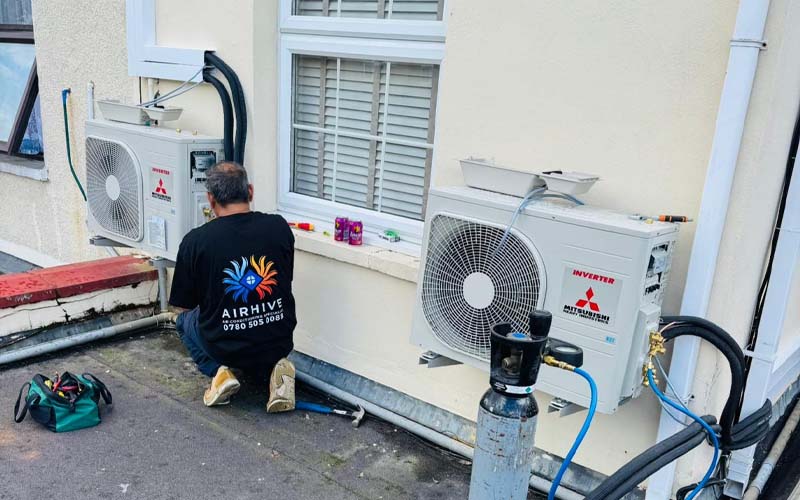
It’s always best to have a professional inspect the refrigerant. Refrigerants require special training and equipment to handle.
5. Test the Ducts
Your air conditioner brings the air to a cold state and forces it out through ducts into your rooms. In case the ducts are punctured or dirty, cold air will not flow into your rooms.
How to inspect the ducts:
Inspect the ducts for holes, dust, or dirt.
Plug any holes with mastic sealant or duct tape.
Vacuum out the ducts.
6. Clean the Surround Area of the AC Unit
Your AC requires air to function effectively. If the space surrounding the outdoor unit is obstructed by plants or dirt, the AC cannot vent out the hot air. The AC will have to work harder and consume more electricity.
How to de-clutter the space surrounding the AC unit:
Ensure there is a minimum of 2 feet of clear space area cover around the outdoor unit.
Trim bushes, plants, or vines inches from the unit.
Cut away leaves, branches, or debris that may obstruct airflow.
7. Check the Condensate Drain
Your AC takes moisture from the air. Water drips into a pan and overflows outside. A clogged drain can cause water damage and lower your AC’s efficiency.
How to inspect the condensate drain:
See if there’s water around the indoor unit.
Use a wet/dry vacuum to drain out the drain line.
Ensure water drains from the unit properly.
8. Schedule a Pro Inspection
Although you can do some things yourself, it’s always better to have a pro inspect your AC each year. They’ll clean up things you can’t reach and repair issues.
Tips to Keep Your AC Running During a Heatwave
Your AC will be running overtime during a heatwave. These simple tips will help it work more efficiently:
Close doors and windows: Close the windows and doors during the day to block hot air.
Make use of fans: Fans circulate the cool air and share the load of your AC.
Set temperature sensibly: Don’t set the thermostat low. Set it between 20°C and 22°C for optimal working.
Use curtains: Close curtains or blinds to block the sun from your house and prevent it from getting hot.
Common AC Problems and How to Fix Them
Even with a well-serviced AC, you may experience some issues with it. Below are some issues and how to detect them:
AC not cooling sufficiently: It could be caused by dirty filters, low refrigerant, or a clogged drain. Start by cleaning the filters and inspecting the refrigerant.
Sussurating noises: If your AC produces unusual noises, such as rattling, something might be loose. Have it fixed by a technician.
Leaks in water: When you have water beside your AC, then your pan may be leaking or the drain line may be blocked. Inspect the drain line and the pan for any leaks.
Final Thought
AC preparation during the London heatwave keeps you cool and comfortable. AC maintenance is what makes your AC operate in the best condition and saves you energy. All you need to do is adhere to these simple tips, and your AC is going to be prepared for the heat. In case there is a fault in maintenance or repair, please contact Airhive UK. Stay cool and have fun!
FAQs
Q1: How often should I clean or replace my AC’s air filter?
Replace or clean the air filter every 1 to 3 months. More frequently, if you have pets or a dusty location.
Q2: How do I know if my refrigerant is low?
See if your AC won’t cool or is blowing warm air. The refrigerant could be low. Call a professional to inspect and recharge it.
Q3: Can I clean the coils myself?
Clean the coils yourself. Use a brush or a vacuum with a brush. Do not damage the slender fins.
Q4: What are some ways I can save energy when using my AC?
Keep your thermostat at 21°C, use air circulation through fans, and shut curtains to keep sunlight out.
Q5: How frequently should I have my professional AC check-up done?
Have a professional check-up performed annually, before the beginning of summer heat.